
A civics curriculum is like any other subject taught in school:
It requires skilled instruction, careful practice, and opportunities to experiment. Constitutional Democracy Project’s lessons and curricula provide authentic civic learning and enable schools to serve as “laboratories” for democratic participation.
Keywords to search by:

High School
-
 Our pluralistic democracy is based on a set of common principles such as justice, equality, liberty.
 -
 In this lesson, students will consider whether Illinois should pass a law requiring all law enforcement officials in the state to wear body cameras.
 -
 Civil Conversation on the 14th Amendment The Fourteenth Amendment fundamentally redefined the central institutions of American civic and political life after the Civil War and remains the bulwark of our Constitutional rights today.
 -
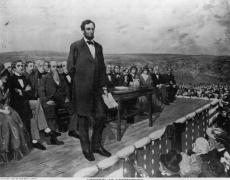 On November 19, 1863, President Abraham Lincoln dedicated the cemetery at Gettysburg, Pennsylvania, where Union and Confederate armies had fought July 1-3 in the decisive battle of the Civil War.
 -
 The U.S. Supreme Court has held that students do not “shed their constitutional rights to freedom of speech or expression at the schoolhouse gate” (Tinker v. Des Moines ISD, 1969).
 -
 The Supreme Court of the United States has interpreted the First Amendment to contain several categorical exceptions to the Free Speech Clause.
 -
 Understanding the Preamble to the U.S. Constitution is important because it sets out the purposes or functions of government as envisioned by the framers.
 -
 Suffrage at 17 is designed to help Illinois high school students take advantage of their right to the franchise.